Supporting Heart Health in the Workplace: Tips for Employers and Employees
Supporting heart health in the workplace is not only beneficial for employees’ well-being but also contributes to a more productive and thriving work environment. For employers, implementing wellness programs that promote heart-healthy behaviors can make a significant impact. Offer incentives for employees to participate in physical activity challenges, provide healthy food options in the cafeteria or vending machines, and organize workshops or seminars on stress management and heart health education. Additionally, consider offering flexible work arrangements to encourage employees to prioritize exercise and self-care.
On the other hand, employees can take proactive steps to support their heart health while at work. Take regular breaks to stretch and move around, opt for stairs instead of elevators, and pack nutritious snacks and lunches to avoid unhealthy food choices. Practice stress-relieving techniques such as deep breathing or meditation during breaks, and prioritize work-life balance to reduce the risk of burnout.
At Centers Healthcare, we believe that by fostering a workplace culture that prioritizes heart health and providing resources and support for employees to make healthier choices, employers and employees alike can contribute to a heart-healthy workplace environment.
To learn more about Cooperstown Center, visit centershealthcare.com/locations/cooperstown-center or call 800-305-9151
Winter Resilience Building
Forge resilience amidst the winter chill with intentional winter resilience building. Embrace the season’s challenges as opportunities for growth, adapting to the changing conditions with a positive mindset. Engage in winter activities that push your comfort zone, fostering mental and physical strength. Prioritize self-care rituals, ensuring your well-being remains a focal point in the colder months. Cultivate connections with loved ones, creating a support network that enhances your resilience. Just as winter transforms the landscape, let this December at Centers Healthcare be a season of personal transformation and fortitude, building resilience that withstands the frosty challenges and blossoms into a stronger, more resilient you.
To learn more about Cooperstown Center, visit centershealthcare.com/locations/cooperstown-center or call 800-305-9151
Benefits of Aquatic Therapy
Dive into the benefits of aquatic therapy for rehabilitation. Explore exercises that leverage the unique properties of water, offering a low-impact yet effective approach to enhancing your rehabilitation journey.
-
Buoyancy and Reduced Joint Impact:
In water, the buoyancy counteracts the effects of gravity, reducing the impact on joints. This is particularly beneficial for individuals with arthritis, musculoskeletal disorders, or those recovering from joint surgeries. Buoyancy allows for gentle movement without placing excessive stress on the joints, making aquatic therapy an ideal option for improving mobility and flexibility. -
Resistance for Muscle Strengthening:
Water provides natural resistance, requiring muscles to work harder during aquatic exercises. This resistance helps strengthen muscles, improve endurance, and enhance overall fitness. Additionally, the resistance is adjustable based on the speed and force of movements, allowing for progressive resistance training tailored to an individual’s specific needs. Aquatic therapy can be particularly advantageous for individuals with conditions such as fibromyalgia or those who need low-impact exercise options. -
Improved Circulation and Cardiovascular Health:
The warm temperature of the water in aquatic therapy pools can promote vasodilation (dilation of blood vessels), which improves blood circulation. This can be beneficial for individuals with conditions such as peripheral vascular disease or those recovering from cardiovascular surgeries. The buoyancy of water also reduces the strain on the cardiovascular system, making aquatic therapy a safer option for individuals with heart-related concerns.
At Centers Healthcare, immerse yourself in the therapeutic benefits of aquatic therapy, with detailed explanations of water-based exercises, expert recommendations, and success stories highlighting the transformative impact of water-based rehabilitation.
To learn more about Cooperstown Center, visit centershealthcare.com/locations/cooperstown-center or call 800-305-9151
Breaking Boundaries with Rehab Technology
Uncover the latest breakthroughs in rehab technology that are reshaping the healthcare landscape. We delve into innovative solutions and how they empower our commitment to patient care. From AI-driven diagnostics to smart rehabilitation equipment, witness the dawn of a new era in personalized and efficient recovery. Journey through the evolution of telerehabilitation, breaking geographical barriers to ensure access to quality care for all. At Centers Healthcare, envision a future where the harmony of technology and compassion transforms healthcare delivery.
To learn more about Cooperstown Center, visit centershealthcare.com/locations/cooperstown-center or call 800-305-9151
Annual Drinking Water Quality Report for 2023
Annual Drinking Water Quality Report for 2023 Centers Healthcare (Cooperstown Center)
128 Phoenix Mills Cross Road, Cooperstown, New York 13326
(Public Water Supply ID: NY3830079)
INTRODUCTION
To comply with State regulations, Cooperstown Center Healthcare will be annually issuing a report describing the quality of your drinking water for Cooperstown Center. The purpose of this report is to raise your understanding of drinking water and awareness of the need to protect our drinking water sources. We proudly report that our system did not violate a maximum contaminant level. This report provides an overview of last year’s water quality. Included are details about where your water comes from, what it contains, and how it compares to State standards. Shean Robinson, Director of Maintenance and water system 607-544-2697. If you have any questions about this report or your drinking water, please contact Shean, who is available anytime to discuss any water system questions. We have our daily staff meetings at 9:00 am/M-F.
WHERE DOES OUR WATER COME FROM?
In general, the sources of drinking water (both tap water and bottled water) include rivers, lakes, streams, ponds, reservoirs, springs, and wells. As water travels over the surface of the land or through the ground, it dissolves naturally occurring minerals. It can pick up substances resulting from the presence of animals or human activities. Contaminants that may be present in source water include microbial contaminants, inorganic contaminants, pesticides and herbicides, organic chemical contaminants, and radioactive contaminants. In order to ensure that tap water is safe to drink, the State and the EPA prescribe regulations which limit the amount of certain contaminants in water provided by public water systems.
Our water system serves approximately 500 people and has one service connection line. Our water source is two groundwater wells that are 250 + or – ft. Well, #1 is located 8’ off the Southwest corner of A-Wing. Well, #2 is located 46’ off the Southeast corner of B-Wing. We pump from the wells alternatingly and do not draw from the surface of the raw water source. The water is treated with chlorine before entering an 188,000-gallon storage tank. This process is monitored daily for correct levels. Chlorine is added to disinfect the well water of any contaminates and kept within NYSDOH guidelines. This is checked each day to maintain levels.
Potential sources of contamination for these wells would naturally include but are not limited to, farming activities, erosion of natural deposits, soil, and storm runoff. The well locations are constantly monitored for any activities that may contaminate them.
ARE THERE CONTAMINANTS IN OUR DRINKING WATER?
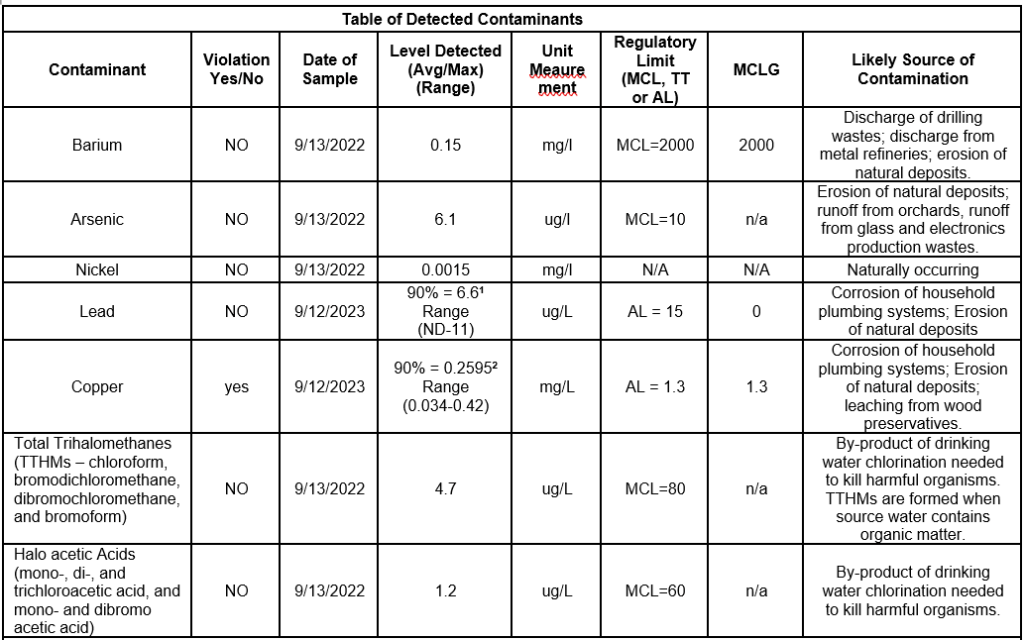
As the State regulations require, we routinely test your drinking water for numerous contaminants. These contaminants include total coliform, inorganic compounds, nitrate, lead, and copper, volatile organic compounds, total trihalomethanes, haloacetic acids, and radiological and synthetic organic compounds. The table presented below depicts which compounds were detected in your drinking water. The State allows us to test for some contaminants less than once per year because the concentrations of these contaminants do not change frequently. Some of our data, though repetitive, is more than one year old.
It should be noted that all drinking water, including bottled water, may reasonably be expected to contain at least small amounts of some contaminants. The presence of contaminants and potential health effects can be obtained by calling the EPA’s Safe Drinking Water Hotline at (800) 426-4791 or the Oneonta (District Office) Health Department at (607) 432-3911.
Footnotes:
1)The level presented represents the 90th percentile of the 5 sites tested. A percentile is a value on a scale of 100 that indicates the percent of a distribution that is equal to or below it. The 90th percentile is equal to or greater than 90% of the copper values detected in your water system. In this case, 5 samples were collected at your water system, and the 90th percentile value was the highest was 420 ug/l, and the next highest was 99 ug/l . The action level for copper was not exceeded at any of the sites tested.
2)The level presented represents the 90th percentile of the 5 samples collected. The action level for lead was not exceeded at any of the sites tested.
Definitions:
- Maximum Contaminant Level (MCL)– The highest level of a contaminant that is allowed in drinking water. MCLs are set as close to the MCLGs as feasible using the best available treatment technology.
- Maximum Contaminant Level Goal (MCLG)– The level of a contaminant in drinking water below which there is no known or expected risk to health. MCLGs allow for a margin of safety.
- Action Level (AL)– The concentration of contaminant, which if exceeded, triggers treatment, or other requirements, which a water system must follow.
- Milligrams per liter (mg/l): Corresponds to one part of liquid in one million parts of liquid (parts per million – ppm).
- Micrograms per liter (ug/l): Corresponds to one part of liquid in one billion parts of liquid (parts per billion – ppb).
- Maximum Residual Disinfectant Level (MRDL): the highest level of a disinfectant allowed in drinking water. There is convincing evidence that addition of a disinfectant is necessary for control of microbial contaminants.
- Maximum residual Disinfectant Level Goal (MRDLG): The level of a drinking water disinfectant below which there is no known or expected risk to health. MRDLGs do not reflect the benefits of the us of disinfectants to control microbial contamination.
WHAT DOES THIS INFORMATION MEAN?
As you can see by the table, our system had no MCL or AL violations. We have learned through our testing that some contaminants have been detected; however, these contaminants were detected below New York State requirements.
We are required to present the following information on lead in drinking water:
Lead can cause serious health problems, especially for pregnant women and young children. Lead in drinking water is primarily from materials and components associated with service lines and home plumbing. [ Centers Healthcare] is responsible for providing high quality drinking water and removing lead pipes, but cannot control the variety of materials used in plumbing components in your home. You share the responsibility for protecting yourself and your family from the lead in your home plumbing. You can take responsibility by identifying and removing lead materials within your home plumbing and taking steps to reduce your family’s risk. Before drinking tap water, flush your pipes for several minutes by running your tap, taking a shower, doing laundry or a load of dishes. You can also use a filter certified by an American National Standards Institute accredited certifier to reduce lead in drinking water. If you are concerned about lead in your water and wish to have your water tested, contact Cooperstown Center, Shean Robinson at 607-544-2697]. Information on lead in drinking water, testing methods, and steps you can take to minimize exposure is available at http://www.epa.gov/safewater/lead.
Arsenic Information
As you can see by the table, our system had no violations. We have learned through our testing that some contaminants have been detected; however, these contaminants were detected below current federal drinking water requirements. Although arsenic was detected below the MCL, it was detected at (6.1 ug/I) which is greater than one-half of the MCL. Therefore, we are required to present the following information on arsenic in drinking water:
“NYS and EPA have promulgated a drinking water arsenic standard of 10 parts per billion. While your drinking water meets the standard for arsenic, it does contain low levels of arsenic. The standard balances the current understanding of arsenic’s possible health effects against the costs of removing arsenic from drinking water. EPA continues to research the health effect of low levels of arsenic, which is a mineral known to cause cancer in humans at high concentrations and is linked to other health effects such as skin damage and circulatory problems.”
IS OUR WATER SYSTEM MEETING OTHER RULES THAT GOVERN OPERATIONS?
We are required to monitor your drinking water for specific contaminants on a regular basis. Results of regular monitoring are an indicator of whether or not your drinking water meets health standards. During 2023 , we did monitor for TC in September .However we did get a violation for sending it in late.
DO I NEED TO TAKE SPECIAL PRECAUTIONS?
Although our drinking water met or exceeded State and Federal regulations, some people may be more vulnerable to disease causing microorganisms or pathogens in drinking water than the general population. Immuno-compromised persons such as persons with cancer undergoing chemotherapy, persons who have undergone organ transplants, people with HIV/AIDS or other immune system disorders, some elderly and infants can be particularly at risk from infections. These people should seek advice from their health care provider about their drinking water. EPA/CDC guidelines on appropriate means to lessen the risk of infection by Cryptosporidium, Giardia and other microbial pathogens are available from the Safe Drinking Water Hotline (800) 426-4791. EPA Website: www.epa.gov/safewater/
Source water assessment Summary
The NYS DOH has completed a source water assessment for this system based on available information. Possible and actual threats to the drinking water sources were evaluated. The State source water assessment includes a susceptibility rating based on the risk posed by each potential source of contamination and how easily contaminants can move through the subsurface to the wells.
The susceptibility rating is an estimate of the potential for contamination of the source water, it does not mean that the water delivered to consumers is, or will become contaminated. While nitrates (and other inorganic contaminants) were detected in our water, it should be noted that all drinking water, including bottled drinking water, might be reasonably expected to contain at least small amounts of some contaminants from natural sources. The presence of contaminants does not necessarily indicate that the water poses a health risk. The nitrate levels in our sources are not considered high in comparison with other sources in this area. See section “Are there contaminants in our drinking water?” for a list of the contaminants that have been detected.
As mentioned before, our water is derived from two drilled wells. The source water assessment has rated these wells as having a high/very high susceptibility to microbial, nitrates, industrial solvents and other industrial contaminants. These ratings are due primarily to the close proximity of permitted discharge facilities (Industrial/Commercial Facilities that discharge wastewater into the environment and are regulated by the State and/or Federal Government) – generally noted as SPDES or NPDES facilities, low intensity residential activities, pasture manure pile(s) and fertilizer use/bulk storage facilities within the assessment area. In addition, the wells draw from fractured bedrock and the overlying soils are not known to provide adequate protection from potential contamination.
While the source water assessment rates our wells as being susceptible to microbial, please note that our water is disinfected to ensure that the finished water delivered into your facility meets New York State’s drinking water standards for microbial contamination.
WHY SAVE WATER AND HOW TO AVOID WASTING IT?
Although our system has an adequate amount of water to meet present and future demands, there are a number of reasons why it is important to conserve water:
- Saving water saves energy and some of the costs associated with both of these necessities of life;
- Saving water reduces the cost of energy required to pump water and the need to construct costly new wells, pumping systems and water towers; and
- Saving water lessens the strain on the water system during a dry spell or drought, helping to avoid severe water use restrictions so that essential firefighting needs are met.
You can play a role in conserving water by becoming conscious of the amount of water your household is using, and by looking for ways to use less whenever you can. It is not hard to conserve water. Conservation tips include:
- Automatic dishwashers use 15 gallons for every cycle, regardless of how many dishes are loaded. So get a run for your money and load it to capacity.
- Turn off the tap when brushing your teeth.
- Check every faucet in your home for leaks. Just a slow drip can waste 15 to 20 gallons a day. Fix it and you can save almost 6,000 gallons per year.
- Check your toilets for leaks by putting a few drops of food coloring in the tank, watch for a few minutes to see if the color shows up in the bowl. It is not uncommon to lose up to 100 gallons a day from one of these otherwise invisible toilet leaks. Fix it and you save more than 30,000 gallons a year.
CLOSING
Thank you for allowing us to continue to provide your family with quality drinking water this year. In order to maintain a safe and dependable water supply we sometimes need to make improvements that will benefit all of our customers. The costs of these improvements may be reflected in the rate structure. Rate adjustments may be necessary in order to address these improvements. We ask that all our customers help us protect our water sources, which are the heart of our community. Please call our office if you have questions.
Cooperstown Center for Rehabilitation and Nursing on the Safety of Popular Activities During the Pandemic
With restrictions being eased in Central New York and most parts of the country, it’s natural to wonder which activities are safe to conduct and which ones still may be a bit risky, especially for the elderly and those with pre-existing health conditions that could be worsened by COVID-19, the disease caused by the novel coronavirus.
Cooperstown Center for Rehabilitation and Nursing has guidance on four different places regarding their level of risk during the pandemic.
Eating at a Restaurant
The main difference seems to be eating outdoors vs. eating indoors. Given that people will be eating and drinking, masks will not be worn among customers. The size of the restaurant and its ventilation are also things you should consider. Employees should be screened for COVID-19 symptoms and wearing masks, and if social distancing is practiced at outdoor tables, your risk is considerably less than it would be indoors.
Getting a Haircut
A haircut will put you in close quarters with one person. You and the hair stylist should both be wearing a mask, and limit your time in the salon by either waiting outside or in your car until you are ready to be serviced. You can also ask the hair stylist to wear gloves while cutting your hair, and it would be best if they changed gloves between clients.
Fitness Centers
Fitness locations like gyms and yoga studios still portend a high risk. People are often close together, breathing heavily and sweating, and likely not wearing masks. Visiting a gym isn’t recommended if there is coronavirus in your community, but you can make it safer by checking to see if employees are wearing masks and the facility is undergoing regular deep cleanings.
Places of Worship
Outdoor services where people are practicing social distancing would be the safest activity. Risk increases by moving services indoors, especially if worshippers are not wearing masks. Even by staying 6 feet apart, people could be at risk because it’s been found that singing can increase the distance that virus particles can travel out of a person’s mouth.
To learn more about Cooperstown Center for Rehabilitation and Nursing and all of the services they offer, visit http://cooperstown-center.facilities.centershealthcare.org/.