Cooperstown Center for Rehabilitation and Nursing With 4 Ways to Make Friends in the Wake of the COVID-19 Pandemic
With so many Americans vaccinated for COVID-19 and ready to begin resuming their lives, it can be difficult for those looking to add to their social circle. Making new friends is generally harder the older we get, and that was before a global pandemic took hold in our society that kept us apart for a year.
But as millions look to get back out and resume their social life, Cooperstown Center for Rehabilitation and Nursing has a look at four ways you can make new friends in this new world.
- Use Technology
The technology you became familiar with in 2020—Facetime, Zoom, Skype, etc.—to reach out to virtual communities. Many meeting groups and organizations are still offering virtual options for gatherings, so you can always test the waters that way. Additionally, a website called www.meetup.com allows you to start local groups or meet other people with similar interests in already-existing groups.
- Be the One to Reach Out
If you have a group of friends that you haven’t seen recently but feel that you’re ready to socialize again, reach out to see if they want to go out to breakfast, go for a walk, or gather to play cards. You may find that other people are also eager to resume activities.
- Be Active in Your Community
Most communities have several places for seniors to go in order to find people with similar interests. You can check a local senior center, church, or membership organizations like the Rotary Club.
- Volunteer
Volunteering is a great way to get around new people that share similar interests and passions, and if you hit it off with a group of people, you can always go to lunch or dinner after you finish your volunteer hours. For some ideas on where you can volunteer, visit www.volunteermatch.org.
To learn more about Cooperstown Center for Rehabilitation and Nursing and all of the services they offer, visit http://cooperstown-center.facilities.centershealthcare.org.
Cooperstown Center for Rehabilitation and Nursing With 3 Ways to Boost Your Retirement Savings
With each day that passes, you’re one day closer to retirement, so the time is ticking to make sure that you have enough saved up to be able to live comfortably once your working days are over. If you’re getting a little close to that magic number but would like to see your retirement accounts grow a bit more, there are some steps you can take now to kickstart your savings.
Cooperstown Center for Rehabilitation and Nursing has a look at three ways to boost your retirement accounts today.
- Review Your Employer 401(k) Match
Check to see how much of your contributions your employer will match into your 401(k) account. Changing your contribution to the max amount that the company will match could give you extra money each year that could be in the thousands.
- Add a Personal IRA
IRAs are a great supplement to your employer-sponsored 401(k) plan. Employer plans are generally limited to mutual funds, while you can branch out to stocks, bonds, and other investments in IRAs. There are also two other potential advantages to IRAs. First, a Roth IRA allows you to pay tax on your contributions today so that the money you get back during retirement is tax-free. Some IRAs also protect you from losses, so they can only grow, unlike 401(k)s that can lose money in regular day-to-day trading.
- Keep Your Fees Down
If you’re active in the stock market, you could see a fair percentage of your gains wiped out by fees and commissions every time you buy or sell an investment. Look for a broker to work with who doesn’t charge commission fees, as this perk is gaining in popularity.
To learn more about Cooperstown Center for Rehabilitation and Nursing and all of the services they offer, visit http://new-paltz-center.facilities.centershealthcare.org/.
Annual Drinking Water Quality Report for 2021
Annual Drinking Water Quality Report for 2020
Cooperstown Center
128 Phoenix Mills Cross Road, Cooperstown, New York 13326
(Public Water Supply ID: NY3830079)
INTRODUCTION
To comply with State regulations Cooperstown Center will be annually issuing a report describing the quality of your drinking water for Cooperstown Center. The purpose of this report is to raise your understanding of drinking water and awareness of the need to protect our drinking water sources. Last year you tap water met all State drinking water health standards. We are proud to report that our system did not violate a maximum contaminant level or any other water quality standard. This report provides an overview of last year’s water quality. Included are details about where your water comes from, what it contains and how it compares to State standards.
WHERE DOES OUR WATER COME FROM?
In general, the sources of drinking water (both tap water and bottled water) include rivers, lakes, streams, ponds, reservoirs, springs and wells. As water travels over the surface of the land or through the ground, it dissolves naturally occurring minerals and can pick up substances resulting from the presence of animals or from human activities. Contaminants that may be present in source water include: microbial contaminants; inorganic contaminants; pesticides and herbicides; organic chemical contaminants. In order to ensure that tap water is safe to drink, the State and the EPA prescribe regulations which limit the amount of certain contaminants in water provided by public water systems. The State Health Departments and the FDA’s regulations establish limits for contaminants in bottled water which must provide the same protection for public health.
Our water system serves approximately 500 people. Our water source is two groundwater wells that are 250 + or – ft. Well #1 is located 8’ off the Southwest corner of D-Wing. Well #2 is located 46’ off the Southeast corner of B-Wing. We pump from the wells on an alternating basis and do not draw from a surface of raw water source. The water is treated with chlorine before going into an 188,000 gallon storage tank. This process is monitored daily for correct levels.
Potential sources of contamination for these wells would naturally include, but not be limited to, farming activities, erosion of natural deposits, soil and storm runoff. The well locations are constantly monitored for any activities that may contaminate them.
ARE THERE CONTAMINANTS IN OUR DRINKING WATER?
As the State regulations require, we routinely test your drinking water for numerous contaminants. These contaminants include: total coliform, inorganic compounds, nitrate, lead and copper, volatile organic compounds, total trihalomethanes and synthetic organic compounds. The table presented below depicts which compounds were detected in your drinking water. The State allows us to test for some contaminants less than once per year because the concentrations of these contaminants do not change frequently. Some of our data, though repetitive, is more than one year old.
It should be noted that all drinking water, including bottle drinking water may be reasonably expected to contain at least small amounts of some contaminants. The presence of contaminants and potential health effects can be obtained by calling the EPA’s Safe Drinking Water Hotline (800) 426-4791 or the Oneonta (District Office) Health Department at (607) 432-3911.
WHAT DOES THIS INFORMATION MEAN?
As you can see by the table, our system had no violations. We have learned through our testing that some contaminants have been detected; however, these contaminants were detected below New York State requirements. In 2007 barium was detected in our cycle for these contaminants. Although it was well below the maximum contaminant levels (MCL’s), it still must be included in this report. Please refer to the table of detected contaminants for levels and possible contaminant sources.
IS OUR WATER SYSTEM MEETING OTHER RULES THAT GOVERN OPERATIONS?
During 2020 our system was in compliance with all applicable State drinking water operating, monitoring and reporting requirements.
DO I NEED TO TAKE SPECIAL PRECAUTIONS?
Although our drinking water met or exceeded State and Federal regulations, some people may be more vulnerable to disease causing microorganisms or pathogens in drinking water than the general population. Immuno-compromised persons such as persons with cancer undergoing chemotherapy, persons who have undergone organ transplants, people with HIV/AIDS or other immune system disorders, some elderly and infants can be particularly at risk from infections. These people should seek advice from their health care provider about their drinking water. EPA/CDC guidelines on appropriate means to lessen the risk of infection by Cryptosporidium, Giardia and other microbial pathogens are available from the Safe Drinking Water Hotline (800) 426-4791. EPA Website: www.epa.gov/safewater/
AWQR Summary
The NYS DOH has completed a source water assessment for this system based on available information. Possible and actual threats to the drinking water sources were evaluated. The State source water assessment includes a susceptibility rating based on the risk posed by each potential source of contamination and how easily contaminants can move through the subsurface to the wells.
The susceptibility rating is an estimate of the potential for contamination of the source water, it does not mean that the water delivered to consumers is, or will become contaminated. While nitrates (and other inorganic contaminants) were detected in our water, it should be noted that all drinking water, including bottled drinking water, might be reasonably expected to contain at least small amounts of some contaminants from natural sources. The presence of contaminants does not necessarily indicate that the water poses a health risk. The nitrate levels in our sources are not considered high in comparison with other sources in this area. See section “Are there contaminants in our drinking water?” for a list of the contaminants that have been detected.
As mentioned before, our water is derived from two drilled wells. The source water assessment has rated these wells as having a high/very high susceptibility to microbial, nitrates, industrial solvents and other industrial contaminants. These ratings are due primarily to the close proximity of permitted discharge facilities (Industrial/Commercial Facilities that discharge wastewater into the environment and are regulated by the State and/or Federal Government) – generally noted as SPDES or NPDES facilities, low intensity residential activities, pasture manure pile(s) and fertilizer use/bulk storage facilities within the assessment area. In addition, the wells draw from fractured bedrock and the overlying soils are not known to provide adequate protection from potential contamination.
While the source water assessment rates our wells as being susceptible to microbial, please note that our water is disinfected to ensure that the finished water delivered into your facility meets New York State’s drinking water standards for microbial contamination.
Definitions:
- Maximum Contaminant Level (MCL)– The highest level of a contaminant that is allowed in drinking water. MCLs are set as close to the MCLGs as feasible using the best available treatment technology.
- Maximum Contaminant Level Goal (MCLG)– The level of a contaminant in drinking water below which there is no known or expected risk to health. MCLGs allow for a margin of safety.
- Action Level (AL)– The concentration of contaminant, which if exceeded, triggers treatment, or other requirements, which a water system must follow.
- Milligrams per liter (mg/l): Corresponds to one part of liquid in one million parts of liquid (parts per million – ppm).
- Micrograms per liter (ug/l): Corresponds to one part of liquid in one billion parts of liquid (parts per billion – ppb).
- pCi/l– Picocuries per liter – A measure of the radioactivity in water.
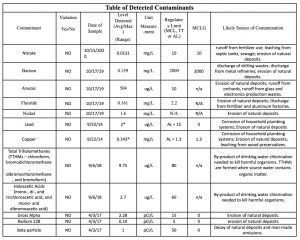
* The level presented represents the 90th percentile of the 5 samples collected. The action level for neither lead nor copper was exceeded at any of the 5 sites tested.
COVID-19 Vaccines are Available for our Staff and Residents!
COVID-19 Vaccines are Available for our Staff and Residents!
According to the CDC:
– The vaccines are highly effective at preventing COVID-19
– They will help keep you from getting seriously ill
– They help protect your family and community
– Vaccines have received Emergency Use Authorizations from the FDA
Talk to the facility administrator or social worker—and get vaccinated today.
COVID-19 Vaccines are Available for our Staff and Residents!
COVID-19 Vaccines are Available for our Staff and Residents!
According to the CDC:
– The vaccines are highly effective at preventing COVID-19
– They will help keep you from getting seriously ill
– They help protect your family and community
– Vaccines have received Emergency Use Authorizations from the FDA
Talk to the facility administrator or social worker—and get vaccinated today.
New Paltz Center for Rehabilitation and Nursing With 5 Foods That Are Marketed as Healthy Yet Are Anything But
Between catchy titles and misleading food titles, foods and drinks can be marketed as healthy yet are anything but. This causes trouble for people trying to lose weight; they think they are making good choices, but they’re sabotaging their efforts without even knowing it.
New Paltz Center for Rehabilitation and Nursing has a look at five foods that nutritionists warn are not healthy despite outward appearances.
- Fat-Free Yogurt
It’s not so much the fat in yogurt that’s the issue; rather, it’s the flavor. The artificial sweeteners, colors, and preservatives to create the flavors are much worse to ingest than full-fat plain yogurt. Choose plain yogurt and add fresh fruit to sweeten it naturally.
- Baked Potato Chips
It’s true that baked chips have fewer calories compared to standard fried chips, but they are more processed than their original counterparts and also contain more sugar. If blood sugar is an issue, stick with normal potato chips if you must indulge.
- Agave Syrup
This is marketed as a “healthier” alternative to sugar, but while your blood sugar won’t rise as much, there is also some harm behind this product. It’s loaded with fructose, which is the type of sugar that’s most harmful and can cause liver problems.
- Protein Bars
Don’t feel like you need a protein bar after a hard workout. While they do contain additional protein, you can usually get what you need from food and be able to avoid the approximately 250 calories per bar, which is equivalent to eating a candy bar.
- Granola
It’s fine to top your oatmeal or yogurt with a quarter-cup of granola, but don’t overdo it, as it’s packed with calories and sugar. Fortified cereals like Cheerios are a better option if you’re planning on eating a bowl of granola.
To learn more about New Paltz Center for Rehabilitation and Nursing and all of the services they offer, visit https://new-paltz-center.facilities.centershealthcare.org/.
Cooperstown Center for Rehabilitation and Nursing With 4 At-Home Workout Moves for Beginners
A common mistake many make when starting an exercise routine is doing too much, too quickly. Then the general difficulty of the workout—or the ensuing soreness—leads the person to quit before they can see results.
With that in mind, Cooperstown Center for Rehabilitation and Nursing has a look at four workout moves that can be done by beginners from the comfort of your own home. These moves are meant to build up your endurance, strength, and agility over time.
- The Pinwheel
The pinwheel helps release tension built up by sitting in a chair and hunched over a computer for hours on end, which improves mobility. Stand with your feet at hip-length apart and extend your arms straight out in front of you. Then slowly raise them over your head, go behind your body and lower them, starting back at the original position. Do that 10 times then reverse direction 10 more times. If you’re feeling ambitious, have one arm go in one direction and the other go the reverse way.
- Walk or Run
If you’re not used to walking or running, start slow to avoid injury. Start with a 20-minute walk. After a rest day, go for 30 minutes. Rest again, then do 40 on day five. Keep this up until you can walk for an hour. Then work on speeding up. Start with a brisk walk, then a speed walk, then a minute of jogging, two minutes, etc. Once you’re jogging more than walking, increase the number of days per week from three to four, then to five.
- Plank
A plank is trying to hold your body still while supporting it with your forearms and toes. You’ll want to keep your head, back, and legs in a straight line once you go into the plank position. Try to hold it for 15 seconds, then up it to 20 the next time, and add a few more seconds to your goal each time you attempt the move.
- Wall Sit
The wall sit will strengthen your core and lower body without putting much strain on you. Stand with your back about a foot away to a wall. Lean until your back touches the wall, then bend your knees and slide down the wall until you’re sitting on an “invisible chair.” Hold for 15 seconds, then slide back up into a standing position. Do three reps of this, increasing the amount of time you’re in the sitting position by a few seconds per rep.
To learn more about Cooperstown Center for Rehabilitation and Nursing and all of the services they offer, visit http://cooperstown-center.facilities.centershealthcare.org/.
Protecting our patients, residents and staff from COVID-19
From the beginning of the coronavirus outbreak, our facility has followed the guidelines and recommendations of the Centers for Disease Control and Prevention (CDC) and the New York State Department of Health (NYSDOH). The safety of our residents, patients, staff and their families are our priority and we continue to take an abundance of precaution to protect them.
Our team is well-trained in the importance of proper handwashing and the use of alcohol-based sanitizer, and all are supplied with proper PPE. If they experience symptoms—such as fever or cough—they are instructed to stay home, and they must be cleared before returning to work.
Handwashing and hygiene posters are displayed throughout our facilities, and employee education and training continue based on the latest community and CDC guidelines. In addition, the COVID-19 vaccine is currently being administered throughout the Centers Health Care facilities to staff and residents alike.
For the latest news about visitation and more, please contact our facility.
Centers Health Care celebrates 25 years of experience, innovation and leadership
25 years of improving lives
25 years of compassionate care
25 years of making a difference
Experience matters and we have it.
We’re proud to be part of Centers Health Care, one of the leading post-acute care organizations in the country.
This year, Centers Health Care is celebrating 25 years of monumental care.
As the leading post-acute healthcare network in the Northeast, Centers’ experience is unmatched, our knowledge unparalleled. We bring more accumulated expertise to the residents and patients we serve than any other post-acute provider in the country, touching more than half a million lives and achieving more than 20,000 successful rehabilitations every year.
Our remarkable insights and ground-breaking achievements over the past quarter-century are exemplary. We have developed programs that have put our company in the top 5% nationwide for successful rehabilitations such as our specialized care units, ranging from a cardiac care unit that has been certified by the American Heart Association to vent and dialysis care.
We have developed unprecedented outreach to the communities we serve—creating units dedicated to community cultures. Centers has, in short, transformed post-acute healthcare…and that’s just the beginning.
We celebrate as we look back at our successes and look forward to our continuing triumphs.
“Over the last quarter-century,” CEO Kenny Rozenberg says, “we have gained the kind of powerful experience in post-acute healthcare that is unmatched in the industry. I am proud and honored to celebrate the 25th anniversary—and look forward to moving ahead, as we write new chapters in the story of Centers Health Care, leading the way for the next 25 years.”
Cooperstown Center for Rehabilitation and Nursing Warns of an Increase in Scams Targeting Seniors During the Pandemic
With the COVID-19 pandemic causing concerns regarding health, financial, and emotional well-being like never before in most of our lifetimes, it’s unfortunately natural to consider that there are people out there preying on the frayed emotions of people, especially our seniors who tend to be more trusting by nature.
Cooperstown Center for Rehabilitation and Nursing has a look at three types of scams that are being perpetrated during the pandemic.
In-Demand Products
At the start of the pandemic in the spring, it was people promising the timely delivery of personal protection equipment (PPE) like face masks, gloves, and hand sanitizer. Most of the scammers would just take people’s money for the order and never deliver anything. Now, the market for illicit products tends to be for COVID-19 cures and treatments that either don’t work or haven’t been proven to. These include teas, essential oils, vitamin C therapies, and other antiviral treatments. Watch for unsolicited calls, texts, and ads on social media sites.
Testing Kits
With the variety of COVID-19 testing kits available by a number of companies, this has become another popular scheme. A person will either advertise a test in order to receive a victim’s personal information for identity theft purposes or will sell kits that they claim can be reimbursed by health insurance (which, of course, doesn’t happen).
Stimulus Payments
A survey back in May found that one in every five people who lost their job early in the pandemic were contacted by scammers about seizing a stimulus payment or unemployment benefits. One way to know if you’re being targeted if the word “stimulus” is used. The official government term is “economic-impact payment.” If you’re suspicious, your best bet is to ask which agency the person is calling from and then call back using the official number for that organization.
To learn more about Cooperstown Center for Rehabilitation and Nursing and all of the services they offer, visit http://cooperstown-center.facilities.centershealthcare.org/.